
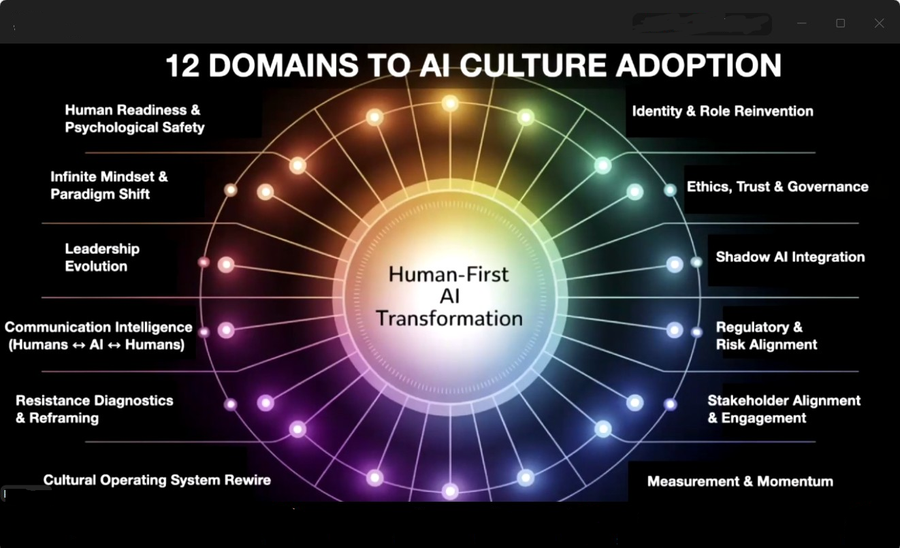
Our adoption framework is built around 12 interconnected cultural dimensions — all oriented around a single principle: Human-First AI Transformation. Each domain is assessed, scored, and actively managed throughout the 18-month program. No domain is optional. All 12 must move for the transformation to be real.
01 · HUMAN FOUNDATION
Human Readiness & Psychological Safety
Assessing whether the organization has created the conditions for people to engage with AI honestly — without fear of judgment, job loss, or being left behind. Psychological safety is the invisible prerequisite for every other domain.
02 · MINDSET
Infinite Mindset & Paradigm Shift
Moving the organization from fixed-role thinking to an ongoing growth orientation where AI capability is seen as continuously expanding — not a one-time implementation with a defined endpoint.
03 · LEADERSHIP
Leadership Evolution
Developing leaders who can model AI-augmented decision-making, articulate a credible human-plus-AI future for their teams, and hold themselves accountable for adoption outcomes — not just deployment milestones.
04 · COMMUNICATION
Communication Intelligence
Designing the communication architecture governing how humans talk to AI, how AI outputs are interpreted and acted on, and how organizations maintain clarity and trust across an increasingly AI-mediated workflow environment.
05 · RESISTANCE
Resistance Diagnostics & Reframing
Identifying the specific sources, patterns, and expressions of AI resistance within the organization — and designing targeted reframing interventions that address the real concern rather than the surface behavior.
06 · CULTURE OS
Cultural Operating System Rewire
The deepest domain — rewiring the informal norms, unspoken assumptions, and habitual behaviors that form the cultural operating system. Without this, every other change remains surface-level.
07 · IDENTITY
Identity & Role Reinvention
Helping individuals reconstruct their professional identity in an AI-augmented environment — moving from “what AI might replace” to “what I can do that AI cannot, and how AI makes that more valuable.”
08 · ETHICS
Ethics, Trust & Governance
Building the ethical framework and governance structures that define how AI is used, what decisions it can and cannot make, how outputs are validated, and how accountability is maintained when AI is in the loop.
09 · SHADOW AI
Shadow AI Integration
Identifying, assessing, and strategically integrating the AI tools employees are already using outside sanctioned programs — converting a governance risk into an adoption asset and source of organizational intelligence.
10 · REGULATORY
Regulatory & Risk Alignment
Ensuring AI adoption occurs within a continuously updated understanding of the regulatory landscape — critical in Life Sciences, Financial Services, and Healthcare where deployment has direct compliance implications.
11 · STAKEHOLDERS
Stakeholder Alignment & Engagement
Mapping and actively managing the full stakeholder landscape — board, executive, middle management, frontline, external partners — ensuring each constituency has a clear, tailored narrative and meaningful role in the transformation.
12 · MOMENTUM
Measurement & Momentum
Defining and tracking the behavioral outcome metrics that indicate whether AI adoption is real — not training completion rates, but measurable changes in how decisions are made, workflows executed, and value created.
See the full program in action
All 12 domains are assessed, scored, and actively managed across the 18-month AI Adoption program — anchored by a named Customer Excellence Senior Consultant from day one.